
Great American Novel: JENSEN-HWANG — Episode 8: The Thirty Days of Sega and RIVA 128
Act III: The Crucible of the Abyss (100% English Edition)

Part 1: The Seven-Million-Dollar Lifeline
The contract had the crisp, unyielding stiffness of heavy parchment, stamped with the red vermilion seal of the Sega Corporation of Japan.
It was late autumn of 1995. The air inside the modest office of NVIDIA in Sunnyvale was thick with the scent of lukewarm black coffee, ozone from overdriven circuit testers, and the bitter copper stench of failing prototypes. The first-generation chip, the NV1, had been an ambitious, audaciously complex gamble. Jensen Huang and his co-founders had attempted to build an all-in-one multimedia beast—a chip that would handle 2D graphics, 3D rendering, audio synthesis, and even arcade gamepad ports on a single silicon die.
To fund this madness, Jensen had flown across the Pacific to Tokyo, securing a pivotal contract with Sega to design the graphics processor for their next-generation gaming console, the project that would eventually become the Sega Dreamcast.
“Seven million dollars,” Jensen whispered, his fingers resting lightly on the edge of the Japanese document. He was thirty-two years old, his black leather jacket hanging over the back of his chair, his white sleeves rolled to his forearms. “Seven million dollars of development capital. It is our entire runway. It pays our engineers, it secures our silicon wafer bookings, and it keeps the electric company from cutting our breaker.”
Across the cluttered workbench, Curtis Priem looked up, his eyes bloodshot behind round spectacles. Between them lay a microscope and a shattered silicon wafer, iridescent fractured pieces reflecting the fluorescent tube overhead.
“It pays the bills, Jense,” Curtis said, his voice flat with exhaustion. “Provided we deliver a chip built on quadratic texture mapping. Provided the world agrees that the future is made of curves.”
Jensen didn’t answer immediately. He walked to the window. Outside, the headlights of late-shift commuters slid along the California highway like sequential data streams on a motherboard.
NVIDIA had staked its entire architecture on curved surfaces—quadratic polygons—believing that mathematical curves were computationally superior to flat, jagged triangles. It was elegant. It was mathematically pure.
And it was about to collide head-on with a freight train named Microsoft.

Part 2: The DirectX Cataclysm
The storm didn’t originate from a rival chipmaker in the valley. It arrived on a single, glossy CD-ROM stamped with the new Microsoft Windows 95 logo.
In late 1995, Microsoft unveiled Direct3D—a core component of DirectX that would define the fundamental rules of three-dimensional software for the next three decades.
Jensen sat in front of an IBM PC workstation, watching the system compiler load the DirectX development kit. Next to him, Chris Malachowsky chewed on an unlit cigar, his brow furrowed so deeply it formed two sharp vertical canyons.
“Look at the pipeline declaration,” Chris said, tapping the CRT monitor screen with the tip of a plastic screwdriver.
Jensen’s eyes scanned the assembly code.
Every single primitive, every rendering call, every rasterization standard built by Microsoft’s engineers was predicated on one absolute geometric truth: triangles. Flat, three-pointed polygons.
Not a single line of DirectX code supported quadratic curves.
“The market has chosen,” Jensen murmured. The words were quiet, but they fell into the bullpen with the weight of an anvil falling onto glass.
If NVIDIA continued building the Sega chip based on quadratic texture mapping, the chip would be completely incompatible with Windows 95 PC games. It would be a dead-end silicon island. Developers writing games for PC would ignore it completely.
“We’re halfway through the Sega contract,” Curtis said, his hands shaking slightly as he set down his soldering iron. “We’ve already spent half of Sega’s seven million dollars. If we pivot to polygons right now, we breach the contract with Sega. We can’t build what they ordered. And if we don’t pivot, we build a chip that nobody in the computer industry will ever buy. Either path… we are dead in six months.”
The bullpen went dead silent. The only sound was the high-pitched whine of a cooling fan on a testing rack.
Jensen stood motionless. The boy who had survived the attic of Tacoma, who had scrubbed the grease traps of Denny’s, looked at the contract and the monitor.
“I am going to Tokyo,” Jensen said.
“To tell them we’re cancelling?” Chris asked, alarmed. “Jense, if you tell them we failed, they will terminate the contract and demand their money back. We don’t have the money to pay them back. It’s spent on wafers and payroll! If Sega sues us for breach, NVIDIA files for Chapter 7 bankruptcy before the weekend.”
“I know,” Jensen replied, his dark eyes locking onto his partners with that calm, terrifying intensity. “Which is why I have to look him in the eyes.”

Part 3: The Bow in Tokyo
The headquarters of Sega in Tokyo rose out of the grey Japanese winter like a citadel of glass and steel.
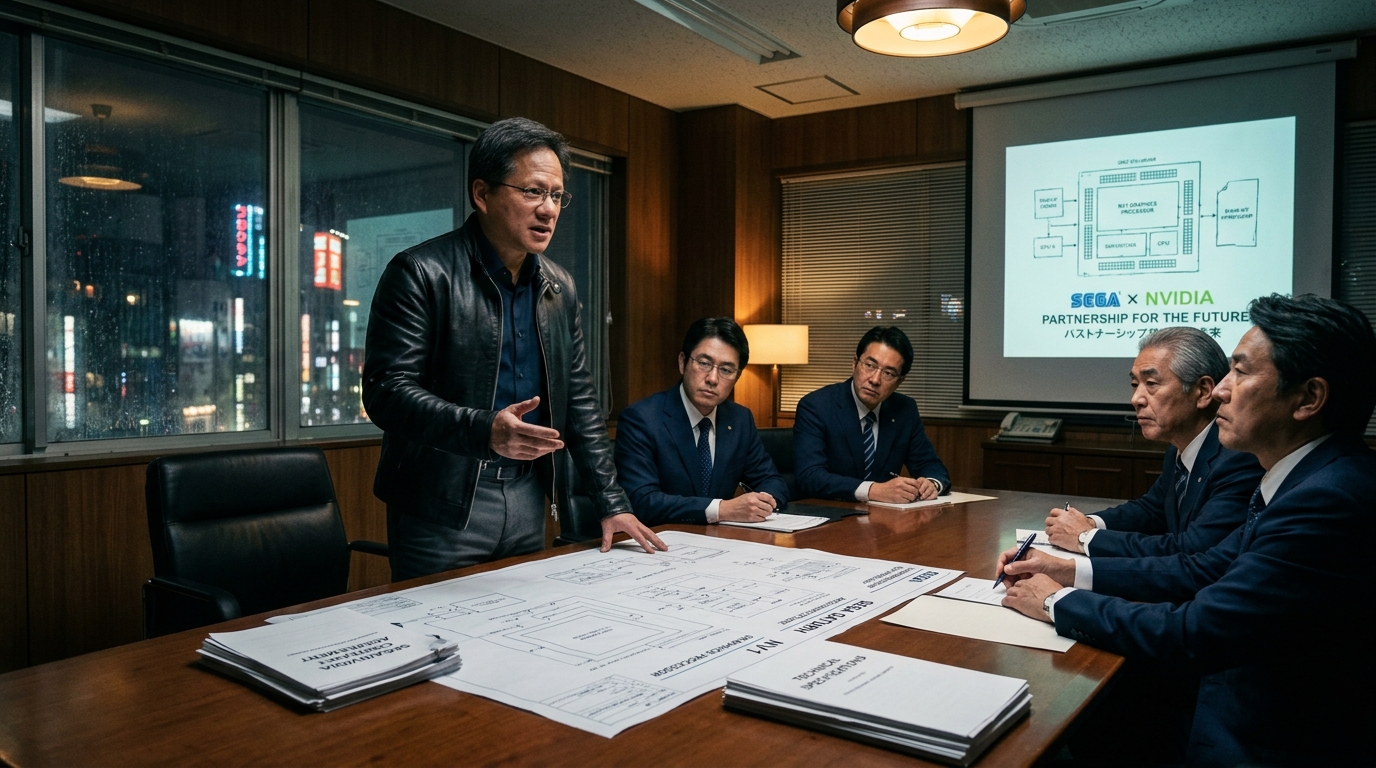
Jensen sat alone in a cavernous conference room on the thirty-second floor. The polished rosewood table was wide enough that the men sitting opposite him seemed framed against the rainy sky of the Tokyo bay.
At the center sat Shoichiro Irimajiri—a legendary figure in Japanese industry, a former Formula One engine designer for Honda who had risen to become the CEO and president of Sega. Irimajiri was a gentleman of towering dignity, his silver-streaked hair immaculate, his tailored navy suit sharp and uncreased.
Jensen wore his black leather jacket. In a culture that treated executive formalwear as a sacred duty, the jacket was an anomaly, but Jensen carried no arrogance.
When Irimajiri entered, Jensen did not pull out a PowerPoint deck. He did not present a sanitized corporate status report with inflated milestones.
He stood up, walked to the center of the tatami-accented carpet, and bowed deeply from the waist—a slow, reverent bow that held for three full seconds.
“Irimajiri-san,” Jensen said, his voice ringing clear and steady in the quiet room. “I have come to tell you that NVIDIA’s NV2 chip for Sega cannot succeed.”
The Japanese executives along the table stiffened. Whispers broke out among the translators.
Jensen continued, his head held high, his wire-rimmed glasses catching the cool grey light from the window. “The architecture we chose—quadratic curved surfaces—is wrong. Microsoft has standardized Direct3D on triangular polygons. If we finish this chip for Sega, it will be inferior, it will fail to capture the gaming market, and it will harm Sega’s dream for its next console. I cannot, in good conscience as an engineer, deliver a flawed weapon into your hands.”
A heavy, suffocating silence descended on the room.
“Mr. Huang,” Irimajiri said slowly in immaculate English, his sharp, perceptive eyes locking onto the young founder. “You are acknowledging that NVIDIA has failed to fulfill the engineering mandate of our agreement?”
“Yes,” Jensen said without flinching. “We must stop development on the NV2 immediately.”
“And what of the seven million dollars Sega committed to you?”
Jensen took a slow breath. He reached into his breast pocket and produced the balance sheet of his company—a single, brutally honest sheet of paper.
“We have spent half of it on development and testing,” Jensen answered with unwavering clarity. “If Sega terminates the contract and demands the return of the capital, NVIDIA will immediately go bankrupt. We cannot refund your money. But if you take that money back, both of us lose. Sega loses its investment entirely, and NVIDIA ceases to exist.”
Jensen stepped forward, placing his calloused hands on the polished rosewood.
“I am asking you for the impossible, Irimajiri-san,” Jensen whispered, his voice vibrating with that raw, magnetic conviction born in the Oregon dish pit. “I am asking you to release NVIDIA from the contract so that we can pivot all our engineering to a brand-new polygonal architecture. And I am asking Sega to invest the remaining five million dollars into NVIDIA’s equity, giving us the lifeline to build the chip that will save us.”
The other Sega directors shook their heads in utter disbelief. It was an unthinkable, outrageous request: to pay a failing startup five million dollars for breaking a contract.
Irimajiri sat motionless for nearly two minutes, watching the young founder. He saw no greed in Jensen’s face, no evasive lawyerly excuses. He saw a man who would rather risk immediate corporate execution than lie to his partner.
Slowly, Irimajiri picked up his fountain pen.
“Mr. Huang,” Irimajiri said, a faint, dignified smile touching his lips. “In racing, when an engine fails, a dishonest driver blames the fuel. A true engineer rebuilds the cylinder. Sega will release you from the contract, and we will invest the five million dollars in NVIDIA.”

Part 4: Thirty Days of Runway
When Jensen returned to Sunnyvale, there was no victory champagne.
The five million dollars from Sega was not a fortune; after paying off supplier debts and pre-ordering memory modules, it represented exactly thirty days of survival.
Thirty days of runway before payroll bounced.
Jensen called an all-hands meeting in the center of the cubicle bullpen. Forty-eight engineers gathered around a central rolling whiteboard. Many of them had families, mortgages, infant children. The fear was a tangible, icy pressure in the room.
Jensen picked up a thick red dry-erase marker.
At the top of the whiteboard, he drew a massive numeral:
30 DAYS.
“We have thirty days of cash left,” Jensen announced. His voice wasn’t somber; it was electric, roaring with a fierce, combative energy that made the fluorescent light ballasts hum. “We have cut half the company’s non-essential programs. We are forty people now. We are going to build a brand-new architecture from scratch: NV3. The RIVA 128.”
He drew a sharp triangle on the board.
“No more curved surfaces. 100 percent triangular polygons. Fully compatible with Direct3D. It must render 3D games faster than 3dfx Voodoo, faster than ATI, faster than Matrox. And we have to design the entire silicon layout, run complete hardware emulation, and send it to the TSMC foundry in Taiwan before that thirty-day clock hits zero.”
An engineer in the third row raised his hand, his face pale. “Jensen, normal tape-out verification takes four months. If there is a single timing bug, a single crossed trace on the silicon, the chip won’t boot. We don’t have the cash for a second tape-out.”
Jensen slammed his marker onto the board tray.
“Then we do not make mistakes,” Jensen roared, his black eyes blazing with an indomitable will. “We run software simulation 24 hours a day. We sleep on the floor under our desks. We eat pizza out of the box. We are going to treat every single gate as if our lives depend on it—because they do! If we fail, we go out in a blaze of glory! But if we succeed, we become the masters of the 3D universe! Let’s get to work!”
For twenty-eight days and nights, the Sunnyvale office never slept. Engineers took turns sleeping on thin foam mats laid directly over the industrial carpet. Jensen was everywhere—ordering food, reviewing bus arbitration logic at 3:00 AM, holding the soldering iron with Curtis, and cheering on the verification team as the emulation clocks ticked down.
On the twenty-ninth day, the tape-out file—millions of transistor vectors compiled into a single master tape—was sent over encrypted fiber lines to Morris Chang’s TSMC fabrication facility in Hsinchu.
The runway was zero. The bank balance was nearly dry.
All they could do was wait.

Part 5: The Dawn of RIVA 128
Three months later, the first batch of packaged silicon arrived from Taiwan in plain cardboard boxes.
It was 6:00 AM on a crisp California morning. The laboratory in Sunnyvale was silent. Jensen, Chris, and Curtis stood around a solitary PC test rig equipped with a prototype RIVA 128 graphics card.
Curtis slotted the card into the PCI motherboard slot, his fingers trembling as he fastened the mounting screw.
Jensen connected the VGA monitor cable. He reached over and pressed the power switch.
The system gave a single, clean BIOS beep.
On the screen, a 3D polygonal racing demo loaded into memory.
Jensen touched the keyboard, hitting the render benchmark.
Instantly, the screen exploded into fluid, breathtaking motion. Polygons moved at blistering speed, textures rendered without a single artifact, light sources glinted off digital sports cars, and the frame counter locked firmly at an astonishing sixty frames per second.
It was twice as fast as the fastest competing graphics card on the planet.
Chris looked at the counter, then at Jensen, his mouth hanging open. “My God… it works. It really works.”
Within four months of release, NVIDIA shipped over one million RIVA 128 units. PC gamers across North America, Europe, and Asia lined up around computer stores to buy the green-boxed cards. The cash flowed in like a torrential river, wiping out debt, hiring hundreds of engineers, and cementing NVIDIA’s name as the undisputed king of PC 3D graphics.
Late that evening, after the wild celebrations in the bullpen had subsided, Jensen walked out to his car.
He sat in the driver’s seat of his old compact car, the night air cool against his face.
He reached into his breast pocket and pulled out his green-grid engineering notebook.
On the inside cover, beneath the faded formulas from Oregon State, he wrote two lines in indelible black ink:
1. “Character is forged at the edge of the cliff.”
2. “We are thirty days from going out of business. Never forget it.”
He zipped up his black leather jacket, the cold metal teeth sliding into place.
He turned the key in the ignition, and drove into the night.
The abyss was behind him.
Wall Street was waiting.
❤️ Enjoyed Episode 8 of Jensen Huang’s Epic?
Click like and subscribe to receive newly released episodes and executive macro reports straight to your inbox.
Join the Discussion (Leave a Reply)
Your email address will not be published. Required fields are marked *
⚖️ [Legal Disclaimer & Copyright Statement]
1. Copyright Notice: All text, literary storytelling, and illustration art in this serialized novel are the exclusive intellectual property of author An Chang-seong (anchangseongbank.blog) and are protected under international copyright treaties and South Korean copyright law. Unauthorized reproduction, adaptation, or commercial distribution is strictly prohibited.
2. Literary Artistic Fiction: This work is a literary dramatization inspired by real historical tech events and corporate narratives. Character dialogues, inner thoughts, and dramatic sequences are artistic creative interpretations designed for literary depth.
3. Financial & Investment Disclaimer: The corporate histories and semiconductor industry analyses discussed herein are provided solely for general educational, historical, and intellectual enrichment. They do not constitute financial advice or an endorsement to buy or sell any security. All investment decisions remain the sole responsibility of the individual investor.
📌 Read Previous Episodes of Great American Novel: JENSEN-HWANG
- 🔗 Great American Novel: JENSEN-HWANG — Episode 7: The Red Sofa of Denny’s
- 🔗 Great American Novel: JENSEN-HWANG — Episode 6: Engineering Class, Three Friends, and $40,000
- 🔗 Great American Novel: JENSEN-HWANG — Episode 5: The Best Dishwasher at Denny’s
- 🔗 Great American Novel: JENSEN-HWANG — Episode 4: The Toilet Scrubber and the Soda Can
- 🔗 Great American Novel: JENSEN-HWANG — Episode 3: The Treaty of the Iron and the Ink
댓글 남기기